
What we want to avoid

What do we call inappropriate behavior?
They are all those that are subject to administrative or disciplinary measures by the relevant legal employer of international personnel (ESO, NAOJ and NRAO / AUI) following its own internal policies and regulations, and by the AUI in its capacity as employer of the local personnel, in particular in the Internal Regulation of Discipline, Hygiene and Safety of Workers of Associated Universities Inc. (AUI).
What do we have to understand, in general?
That JAO staff must refrain from engaging in conducts considered prohibited at all times and in all places related to their work, whether on the ALMA Site or during business trips, meetings and conferences in places other than the Observatory, or while visiting the localities near the ALMA Site in the Atacama territory.
And in particular?
Conducts such as sexual and labor harassment, arbitrary discrimination, bullying, physical or verbal aggression and abuse of authority are understood as prohibited.
What is the definition of harassment?
Harassment is any verbal or physical conduct that can be reasonably considered or perceived as degrading, humiliating, offensive or that shows hostility or aversion towards another person, or that creates a threatening or hostile work environment. It is important to note that harassment is not defined by the intent of the offender but by its impact on the recipient.
Behaviors that involve harassment include, but are not necessarily limited to:
- Insults, defamation or negative stereotypes.
- Threats, intimidation or any other hostile acts.
- Derogatory jokes.
- Any written or graphic material that disparages or shows hostility or aversion towards someone or a group; placed on the walls or in any other place in the premises of the Observatory, or circulating within the workplace, either electronically or in print.

We understand it as sexual advances, requests or any other behavior of a sexual nature carried out improperly, by any means and that is not consented to by the recipient.
Sexual harassment can include a variety of behaviors, subtle or not, and can involve people of the same or different gender.
In practice, the following should not happen:
- Uninvited sexual insinuations or requests for sexual favors.
- Indirect or sexual jokes.
- Verbal abuse of sexual nature.
- Comments regarding a person’s body, sexual prowess, or sexual deficiencies.
- Gazing with malice; whistling or touching.
- Insults or obscene comments or gestures.
- Publicly exhibiting sexually suggestive photos or objects in the workplace.
- Any other verbal or physical conduct of a sexual nature.
Example: Francisco calls Constanza to his office. He wants to congratulate her on her good performance. When he arrives, Francisco closes the door.

In ALMA JAO, our fundamental values lead us to promote respect among people, avoiding at all times any situation that may have a negative impact on their dignity.
What do we understand by this?
Any conduct that is defined as harassment in the workplace that creates an intimidating or hostile work environment directed at an individual or group of staff. It typically involves a series of incidents, but it can be a one-off, one-off incident.
Job performance appraisal, job-related disagreements, requests from supervisors or other staff members to a colleague, or request to properly complete their work is not normally considered harassment, unless done in a demeaning or intimidating manner, or in any other way that is inappropriate.
In practice, the following should not be performed:
- Intimidate a colleague or report
- Undermine the dignity of the person
- Any other similar behavior
Example: Juan submits a report with errors. When Marcela — his supervisor —realizes the mistake, calls Juan at her office and says:

At ALMA JAO, we tolerate mistakes and, above all, we act according to our fundamental values, maintaining respect and dignity for all colleagues.
What do we understand by this?
Any distinction, exclusion or restriction that cannot be reasonably justified and that causes deprivation, confusion or threat to the legitimate exercise of their fundamental rights, in particular when based on matters of race, nationality, ethnic or cultural origin, sex, sexual orientation, situation social or economic, ideology or political opinion, religion or belief, union or participation in commercial associations or not, marital status, age, affiliations, personal appearance, illness or disability.
In practice, you should not have or perform behaviors that:
- Are intended to create a hostile or offensive effect in the workplace.
- Are intended to unfairly or unjustifiably interfere with the performance of the affected worker in the workplace.
- Affects in any other way the worker’s job opportunities.
Example: Fernando and Pedro talk about a project. They have a question about how to implement it. Pedro asks Fernando:
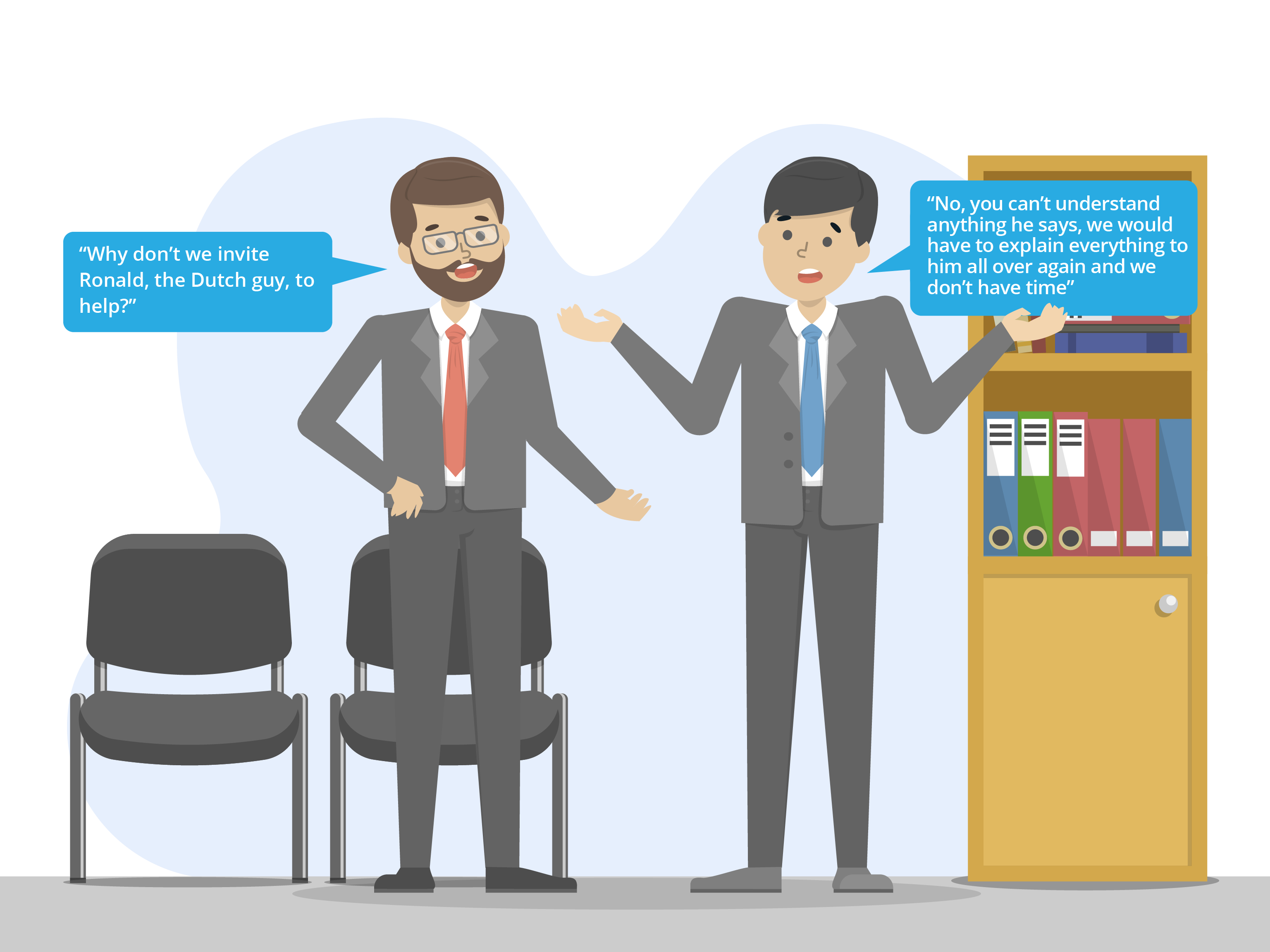
At ALMA-JAO, one of our fundamental values is respect and diversity, and we also promote and are responsible for fostering collaborative work among all members of the organization.
What do we understand by this?
Any aggressive or uninvited conduct in the workplace or in relation to work, that is verbal, psychological or physical and that can be reasonably considered as humiliating, degrading, offensive, intimidating or discriminatory against another ALMA employee or that has the effect of creating a hostile or offensive atmosphere in the workplace.
Considerations about bullying:
Bullying is normally persistent and follows a pattern, but it can also occur as an isolated incident. Bullying is usually carried out by an individual, but it can also be a group or collective behavior, which is called harassment. Exercising appropriate authority and providing constructive feedback as part of job duties and scientific or professional discussion conducted respectfully is not considered harassment.
In practice, you should not have or perform:
- Aggressive conduct which could also include intimidation, threats, blackmail or coercion.
- Deliberate offensive comments related to professional skills, personal traits, or any personal comment that happens to be abusive or disagreeable and which diminishes whoever receives it, including name-calling, insults, bad jokes or negative stereotypes.
- Examples of bullying include, among others:
- Verbal bullying (such as threats, defamation, ridiculing or slander, abusive or offensive comments).
- Physical bullying (such as shoves, blows, attacks or threats of attacks or damage to the workplace or the property), threatening, intimidating gestures or sabotaging the work of the victim.
Example: Francisca and Josefina are in a meeting. They are waiting for Rodrigo to join.

At ALMA JAO, respect for one another is an essential part of our corporate values. Relationships between colleagues should always adhere to those values.
Other inappropriate conducts
What do we have to understand, in general?
Any other conduct that is considered inappropriate in the workplace will be discouraged or repressed, as the case may be, according to the procedures described in this Code.
And in particular?
Although not exclusively, we are referring to behaviors that fall within one of the following definitions:
Abuse of authority: misuse of a position of influence, power or authority against another person, particularly if it is done with the intention of improperly influencing the career or conditions of employment of another person.
Hostile work environment: inciting, through persistent disruptive actions, discriminatory behaviors or communications that alter normal working conditions, and that make one or more employees feel uncomfortable, fearful, or intimidated in the workplace.
In practice, these translate to behaviors and/or attitudes such as:
- Constantly interrupting a colleague or someone taking part in a meeting.
- Attempting to assert authority during a conversation or discussion among other colleagues.
- Shouting.
- Making inappropriate, scornful, or denigrating comments regarding others.
- Exclusionary attitudes, like deliberately leaving a colleague out of a discussion or a chain of e-mails, or not acknowledging their contribution to a certain task, etc.
- Addressing another person in a vulgar or profane manner.
- Harassing or pestering someone else in any way.
- Any other conduct or attitude that might be considered violent or threatening.
Serious and/or repeated breach of ALMA security regulations in force for the JAO.
Any violation of the internal regulations applicable to the JAO, as well as the internal regulations of the Executives.